

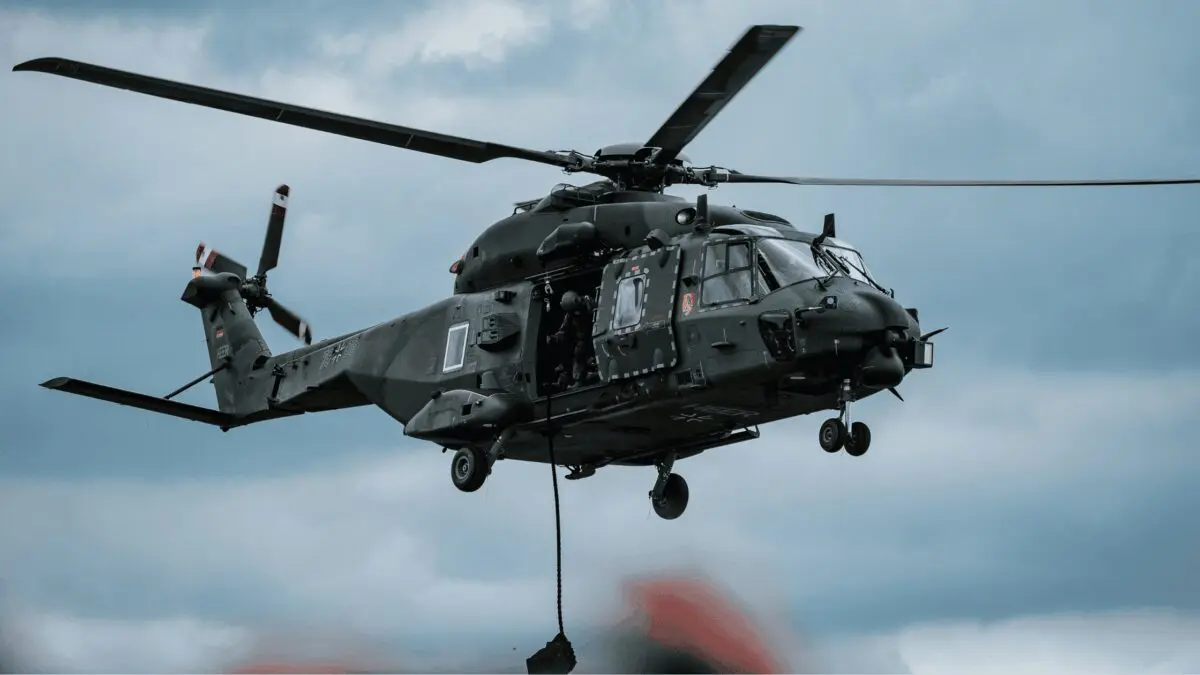
SOF Week returned to Tampa this May as the premier gathering of the global special operations community. Members of the Arsenal team walked the exhibition floor, attended panel discussions, and met with operators, program managers, and technology developers. Here is what stood out.
1. Autonomous systems are moving from demonstration to deployment
The gap between “technology demonstrator” and “operational capability” closed visibly this year. Small uncrewed aerial systems capable of contested-environment navigation, autonomous underwater vehicles designed for coastal intelligence gathering, and ground robots built for logistics in denied terrain were no longer positioned as future programs, they were discussed in the context of current exercises and real-world integration.
The conversation among procurement officials and industry alike has shifted from “can it work?” to “how do we train to it, sustain it, and maintain human control at the right points in the kill chain?” That is a meaningful maturation signal. Companies that understand the operational integration problem, and have an advanced hardware product, are the ones attracting serious program interest.
2. Signals intelligence and electronic warfare are converging at the edge
Multi-domain operations demand that small teams sense, understand, and act faster than ever before. A recurring theme across panels was the compression of the SIGINT-to-decision timeline at the tactical edge, putting more sophisticated electromagnetic spectrum awareness into smaller form factors carried by smaller teams.
“The question is no longer whether special operations forces need organic EW capability. The question is how small we can make it.”
Software-defined radio architectures, AI-assisted signal classification, and low-SWaP (size, weight, and power) packaging were front-and-center conversations. This is an area where the lower middle market is genuinely competitive: agile firms with domain-specific expertise are outmaneuvering larger primes on both development speed and cost.
3. AI is being stress-tested against operational reality
Artificial intelligence was everywhere on the exhibition floor, and so was skepticism from the operator community. The tension is productive. End users are demanding that AI-enabled tools demonstrate reliability under degraded conditions: limited connectivity, spoofed data, novel environments, and the irreducible fog of actual operations.
The companies generating the most credible interest are those that can explain not just what their model does, but when it fails, how it fails, and what the operator should do about it. Trust calibration, helping users know when to rely on algorithmic outputs and when to override them, emerged as a genuine differentiator. Explainability is no longer a compliance checkbox; it is a tactical requirement.
4. Sustainment and logistics are having a technology moment
Force readiness depends as much on the supply chain as on the technology itself, and the SOF community is increasingly vocal about it. Additive manufacturing for forward-deployed parts fabrication, predictive maintenance using sensor-driven condition monitoring, and digital twin approaches to equipment lifecycle management all had substantive representation this year.
This is a segment that has historically been underserved by innovative small businesses, partly because the problems are less glamorous than the platforms they support. But the economics are compelling, the customer base is captive, and the stickiness of sustainment contracts — once embedded — is high. From an investment standpoint, sustainment-focused businesses with proprietary data assets and platform integrations are worth close attention.
5. Allied interoperability is a growth driver, not just a policy goal
The international presence at SOF Week grows each year, and the programmatic implications are real. Allied special operations forces are purchasing U.S. technology and platforms at increasing rates, and the interoperability requirements that come with joint operations, shared communications architectures, common data standards, and compatible authentication frameworks, are driving procurement decisions on both sides of the Atlantic and Pacific.
For U.S.-based companies, this creates market expansion opportunities that are more accessible than traditional FMS pathways might suggest, particularly in the C2 software and data link categories where customization for partner nation requirements is achievable at relatively low additional cost. ITAR considerations remain material and require careful navigation, but the demand signal is clear.
The bottom line
SOF Week 2026 reinforced what the data already suggests: the special operations community is one of the most technologically demanding, operationally credible customer sets in the defense market. The operators who walk the floor are also, in many cases, the end users providing requirements that shape procurement. That connection between demand signal and buying authority compresses the feedback loop in ways that are unusual even within defense.
For companies operating in this space, the opportunity is real — but so is the bar. Technology has to work under conditions that are harder than any test range, supported by people who understand the mission at a granular level. The firms that clear that bar consistently are the ones worth backing.