

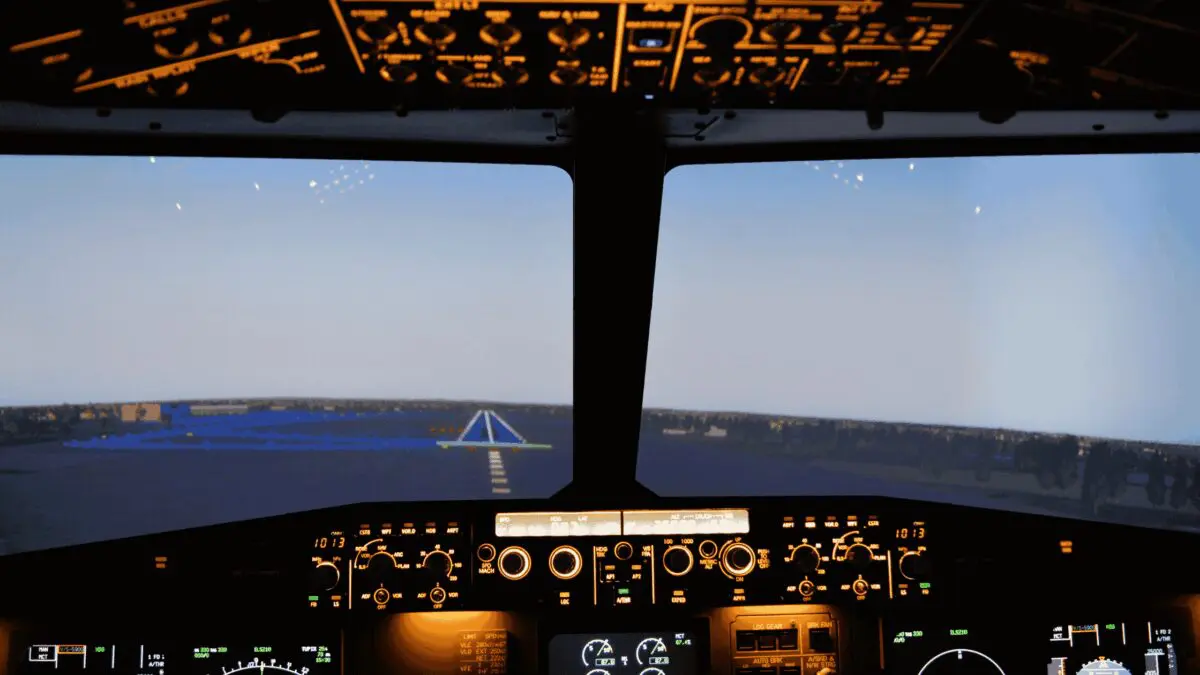
For decades, military readiness meant flight hours, live-fire ranges, and boots on the ground. Those fundamentals haven’t disappeared, but the economics, the technology, and the threat environment have all shifted in ways that make simulation not just a complement to live training, but increasingly the backbone of it. That shift has significant implications for defense procurement, industrial consolidation, and where capital is flowing in the lower middle market.
The Readiness Problem Has Changed
The United States military faces a readiness paradox. The platforms it fields, fifth-generation fighters, advanced rotorcraft, next-generation ground systems, are more complex than anything that came before. Training pipelines that once took months now take years. Meanwhile, the cost of flying a single F-35 sortie exceeds $35,000 per hour, and aircraft availability rates have remained a persistent challenge across the services.
At the same time, the operational tempo of near-peer competition demands higher proficiency, more frequently tested. You can’t train a pilot for multi-domain contested airspace on occasional live sorties. You can’t prepare a crew for electronic warfare degraded environments without replicating those environments — something that is extraordinarily difficult, and often prohibited, in live training scenarios.
Simulation closes that gap. Modern synthetic training environments can replicate contested electromagnetic spectrums, adversary tactics derived from real intelligence, and multi-domain scenarios that simply cannot be safely or legally executed in live settings. For the first time, the fidelity of simulation has caught up with the complexity of the fight.
Ukraine Changed the Calculus
The ongoing four-year conflict in Ukraine, has been a forcing function for how defense establishments worldwide think about training technology. Several lessons have resonated directly at the Pentagon and with allied defense ministries.
First, the consumption rate of trained personnel in high-intensity conventional conflict is severe. Maintaining a steady flow of proficient operators requires training infrastructure that scales. Live training does not scale easily or cheaply. Simulation does.
Second, the conflict demonstrated the centrality of electronic warfare, drone operations, and sensor fusion at the tactical edge. These are domains where simulation-based training offers significant advantages. You can inject realistic EW environments, run thousands of drone engagement scenarios, and test sensor integration without the physical or regulatory constraints of live exercises.
Third, allied cohesion matters. NATO members accelerated investment in interoperable simulation environments precisely because live multinational exercises are expensive and infrequent. Synthetic environments allow allied forces to train together regularly, at scale, without the logistics burden of physical exercises.
The result has been a measurable shift in defense budgets. DoD’s modeling, simulation, and training technology budget has grown consistently, with particular acceleration in ground combat simulation, aviation training systems, and cyber range infrastructure. This isn’t a temporary spike but rather a structural reassessment of how readiness is built and sustained.
Budget Tailwinds Are Real
Defense budgets are political documents as much as they are strategic ones, so sustained increases warrant scrutiny. But several structural factors suggest the investment in simulation and training technology is durable rather than cyclical.
The cost argument is straightforward and compelling. The Army’s Program Executive Office for Simulation, Training, and Instrumentation — PEO STRI — has consistently demonstrated cost-per-training-event ratios that favor simulation by an order of magnitude over live alternatives. For a service under pressure to justify expenditures to Congress, simulation offers genuine cost-effectiveness data. That’s a different and more defensible position than many defense programs.
The capability argument is equally strong. Advanced persistent threat simulation, live-virtual-constructive training architectures, and AI-driven after-action review are capabilities that simply did not exist a decade ago. The services are buying capability improvements, not just cheaper versions of existing training.
Finally, the CMMC 2.0 compliance environment and broader DoD modernization priorities favor established, mission-focused primes and their supply chains over generic IT providers trying to enter the defense space. Companies that have built durable relationships, security clearances, and program-specific institutional knowledge have defensible competitive positions that new entrants struggle to replicate.
Where the Consolidation Opportunity Lives
The simulation and training technology market has a structural feature that creates consistent deal flow for investors paying attention: it is fragmented at the sub-prime level in ways that are unlikely to persist.
The large primes have built substantial simulation portfolios. But below them sits a layer of highly specialized, often founder-led businesses that provide niche capabilities: specific platform emulation, particular sensor simulation, custom after-action review software, specialized instructional systems design. Many of these businesses have long-tenured government relationships, sole-source contract vehicles, and EBITDA margins that reflect genuine competitive pricing.
These companies are underserved by traditional private equity. They are often too small for the large defense-focused buyout funds, too complex for generalist lower middle market players unfamiliar with ITAR, CMMC requirements, and the nuances of government contracting. The result is a segment where valuation remains reasonable relative to the quality of the underlying cash flows and the strategic value of the assets.
The thesis is not complicated: identify and acquire businesses with durable program positions, clear compliance posture, and technical capabilities that are difficult to replicate. Build through add-on acquisitions that create capability breadth. Exit to the primes who need these capabilities and cannot easily build them organically.
What This Means for the Sector
Simulation is not a niche within defense technology. It is becoming the infrastructure layer through which the military builds and sustains the readiness that underwrites deterrence. The technology has matured. The budget commitment is real. The industrial base is fragmented in ways that create opportunity for disciplined consolidators.
For capital focused on the defense lower middle market, the simulation and training sector offers what matters most: durable demand, defensible competitive positions, and a clear strategic logic for consolidation. The window to build at reasonable entry valuations will not stay open indefinitely as more capital recognizes what the military already knows. Simulation is no longer supplemental to readiness. It is readiness.
Arsenal Enterprise Capital pursues control buyouts in C5ISR and simulation technologies in the lower middle market. Views expressed represent the firm’s analytical perspective and do not constitute investment advice.